Using the Documentation
Welcome to the Automic Automation documentation. Whether you are a system administrator configuring environments, a developer writing automation scripts, or an operator monitoring Workflows, this documentation provides the concepts, procedures, and reference materials you need to automate and orchestrate your IT processes.
The Broadcom TechDocs site provides a fast, unified, and feature-rich search and browsing experience designed to help you quickly find the exact information you need.
Navigating the Documentation Site
The documentation site includes built-in tools to help you find accurate information quickly without losing your place.
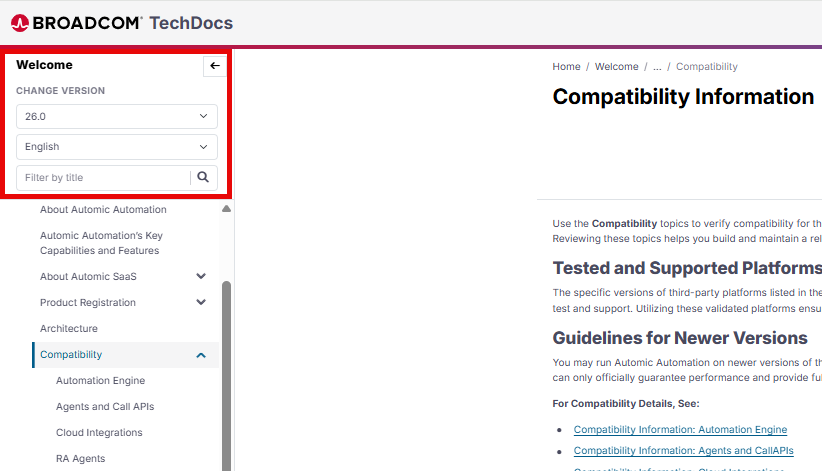
Left Panel
-
Use the Change Version drop-down list at the top to easily switch between different releases of Automic Automation .
-
Below that, use the Filter by title field to narrow down the Table of Contents and find specific topics faster
Center Panel
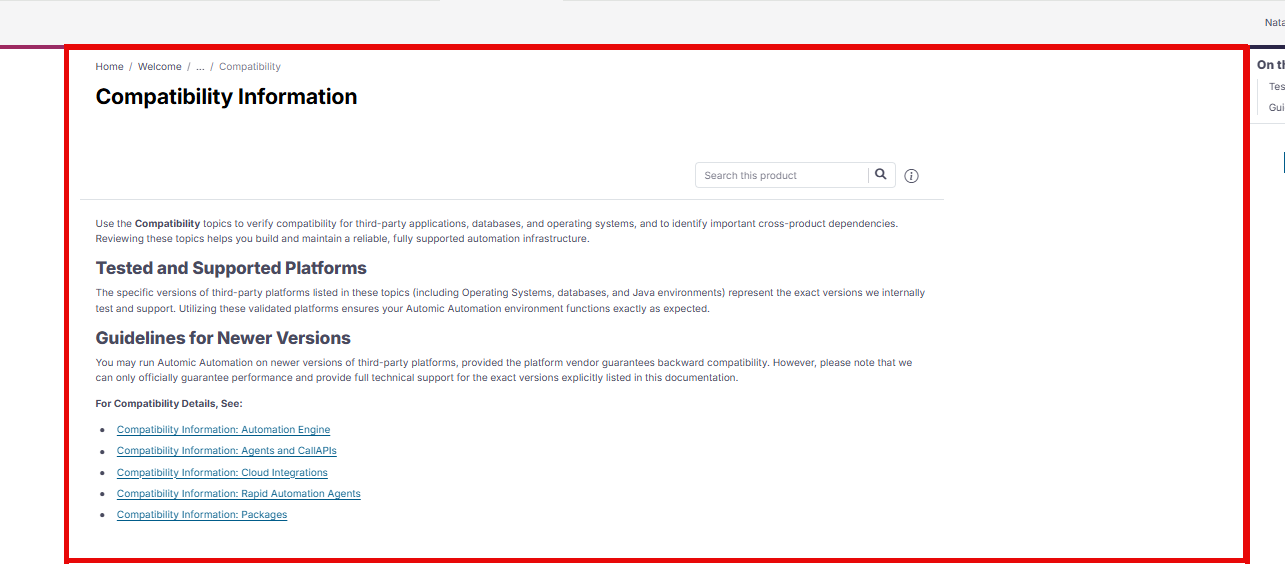
This is your primary reading area.
At the top of this panel, you will find the Search this product field. The site utilizes an agentic search tool that understands context to deliver highly targeted results. Click the (i) information icon next to the search bar to view a quick list of best practices for querying.
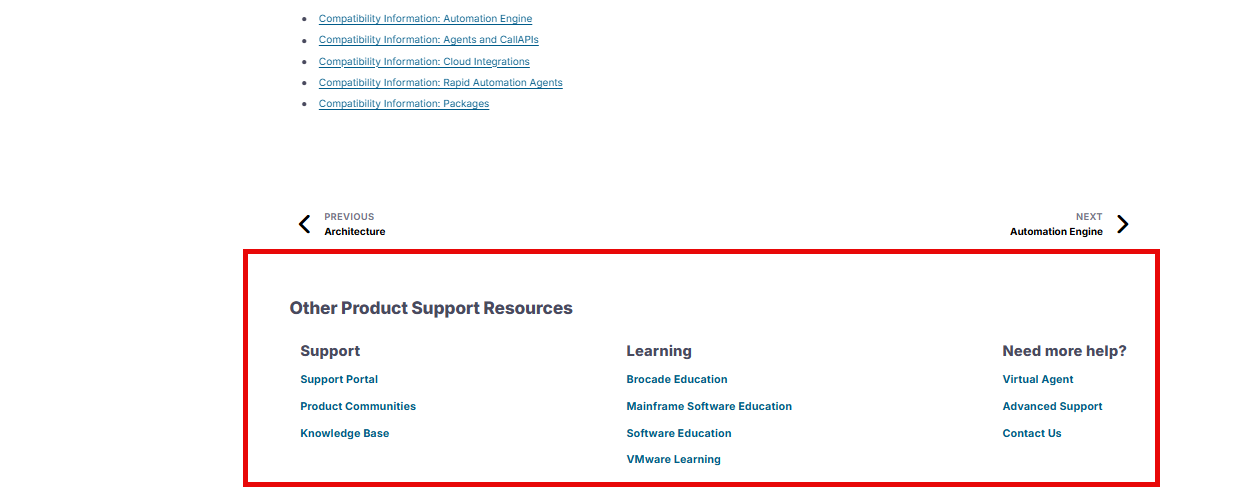
At the bottom of this panel, the Other Product Support Resources section provides quick links to software downloads, the support portal, and community forums, see
Right Panel
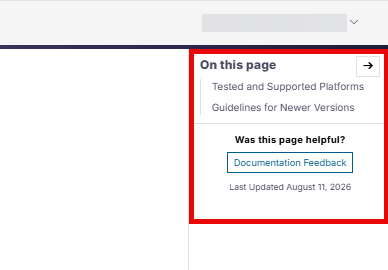
Use the On this page section to see a mini table of contents for the current topic, allowing you to jump directly to the heading you need.
At the bottom of this panel, use the Was this page helpful? widget to send our documentation team direct feedback.
Documentation Sections and Target Audience
To help you find what you need, the Automic Automation documentation is organized to match your user journey, role, and daily tasks. Whether you are discovering the product for the first time or looking for advanced configuration details, the documentation is divided into the following main areas:
| Guide | Description |
|---|---|
| Welcome topics | In addition to providing useful information about the release policy, Broadcom's Marketplace and Support, and so on, this section introduces you to Automic Automation and Automic SaaS. See About Automic Automation and About Automic SaaS. |
| What's New |
Summary of the new features in a version of the software and links to the topics in the documentation that deal with them. |
| Getting Started with Automic Automation |
Read these topics to get acquainted with the UI and to learn about useful functions that make your work more comfortable. The Getting Started section also provides topics that describe the first steps for all user roles. |
| Getting Started with Automic SaaS | Read these topics to understand the essential first steps so that administrators, object designers and operators can quickly set up the system, and run the first Job and monitor it respectively. |
| Using Automic Automation |
Addressing mainly (but not only) developers, object designers and operators, this guide describes functions and provides examples that illustrate them. It also contains all you need to know about the Automation Engine scripting language. |
| Administering and Configuring |
Meant for system administrators, this guide contains information about user and authorization management, security, configuration and house-keeping activities. |
| Installing Automic Automation |
Also meant for system administrators, this guide contains guidelines for planning, installing and updating the solution and all its components. |
| Integrating in Automic Automation |
This guide provides guidelines for integrating Automic Automation with third-party systems. |
| Reference |
Here you can find many useful reference lists, such as INI file configuration, predefined variable and VARA object settings, API parameters, descriptions and examples of script elements and many more. |
| Telemetry - Usage Data | Information about how to collect and send telemetry data (product usage and system configuration data) to Broadcom. |
Using Context-Sensitive Help in the Automic Web Interface (AWI)
When working in tAWI, you can instantly access documentation directly related to the page you are currently using. This context-sensitive help saves you time by bringing the exact information you need right into your workspace, eliminating the need to manually search for topics.
To trigger context-sensitive help, click the ? (Help) icon located in the AWI main menu bar.
Depending on how your system administrator has configured your environment, the documentation will open in one of two ways. Both methods provide the same continuously updated information.
For System Administrators: The behavior of the Help icon is controlled globally via the ipce.properties configuration file. For details on how to switch between the slide-out panel and the external browser tab, see ipce.properties - Enabling/Disabling the Automic Automation Help.
The In-Product Help Panel
If your administrator has enabled the integrated help feature, clicking the Help icon opens a slide-out panel directly within the AWI. This is highly efficient, as it allows you to read the documentation while keeping your current tasks and configurations visible on the screen.
The In-product Help panel includes the following functions in the menu bar:
-
Docking and Undocking the Panel
By default the panel opens in undocked mode over the content of the AWI page. Click the Dock icon in the menu bar to dock it.

-
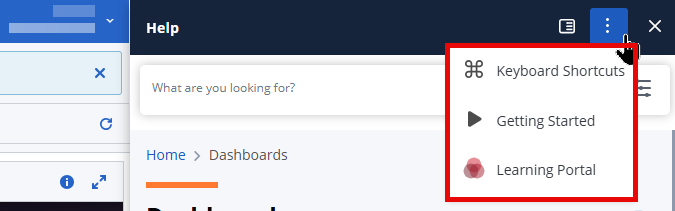
Keyboard Shortcuts
To open the documentation topic describing the keyboard shortcuts, click the three dots in the menu bar and select Keyboard Shortcuts.
-
Dashboard Videos View
Each major version is delivered with videos on AWI's Home page that describe some of the most important new features of that version. The Getting Started option opens this AWI page.
-
Access to the Broadcom Software Academy
To open the Broadcom learning portal in a new browser tab, click the three dots in the menu bar and select Learning Portal.
-
Closing the panel
Click the X (Close) icon in the top right corner of the panel.
The in-product panel consists of two main navigation areas, the Contextual Help and the Home view:
-
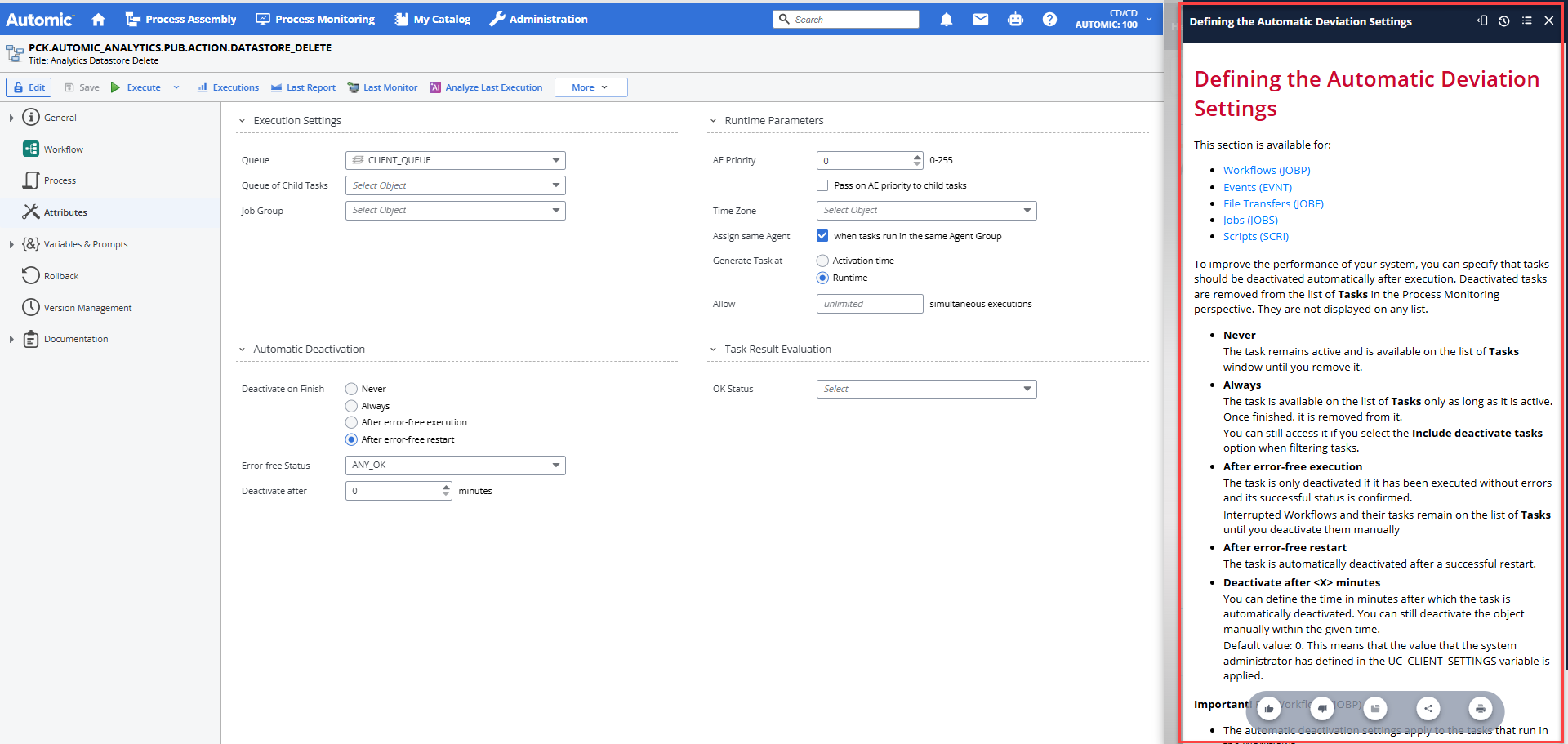
Using the Contextual Help
When you click the Help icon, the help panel automatically opens to the Contextual Help with targeted page descriptions, definitions and requirements for the specific fields, drop-down menus and options.
-
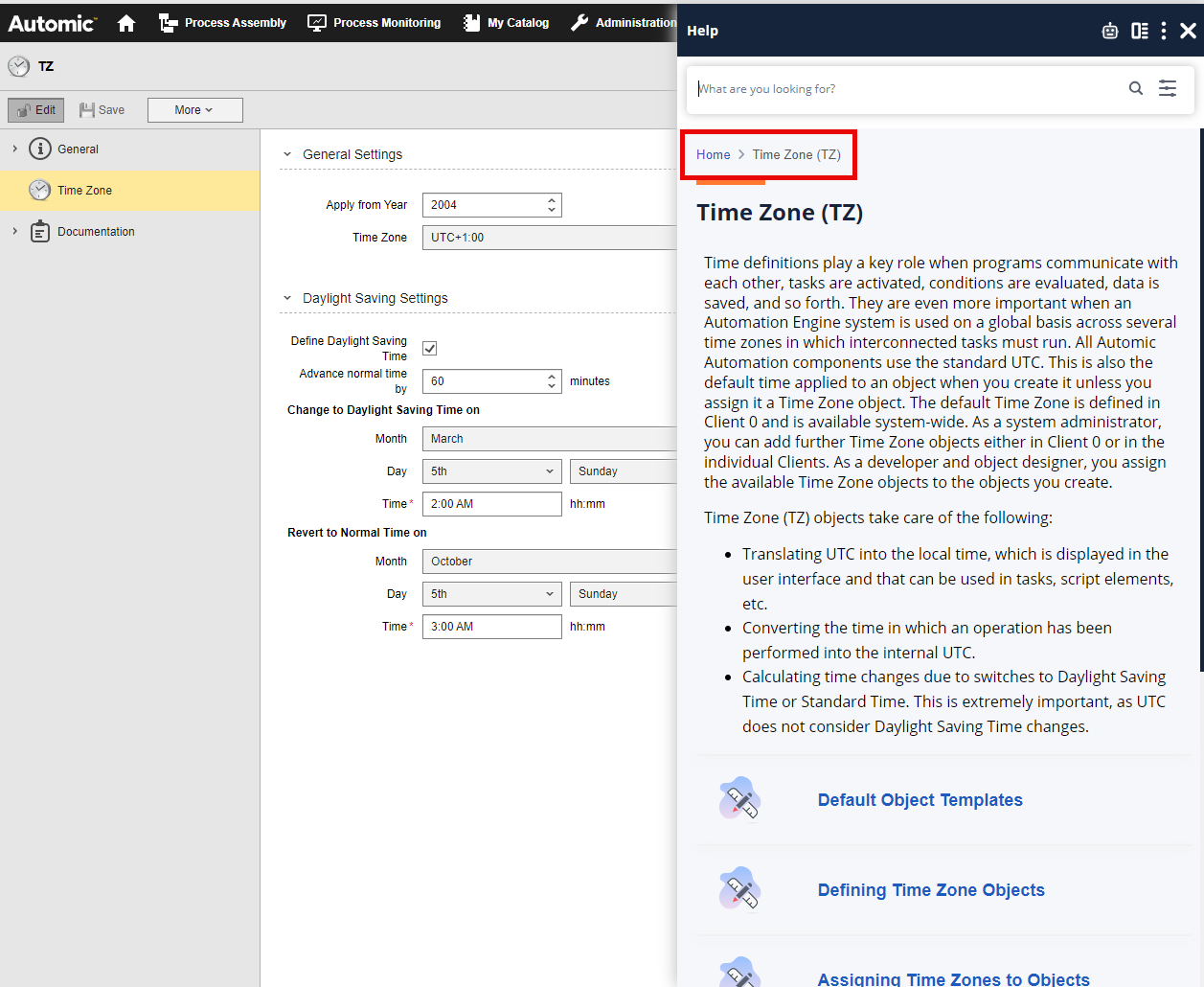
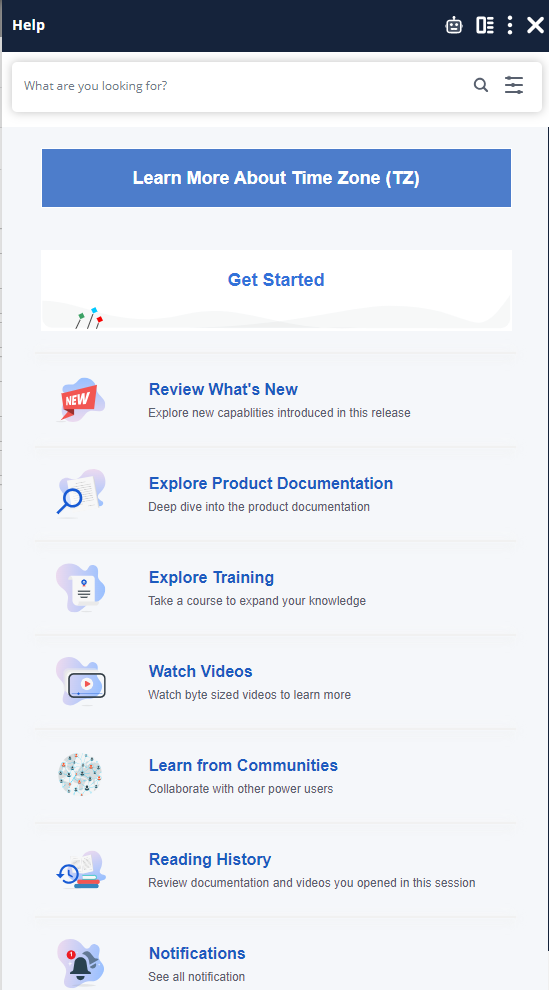
Navigating the Home View
While the Contextual Help gives you focused answers, you may sometimes want to search the entire documentation library or watch a video tutorial. To do this, click the Home link at the top of the panel to switch to the broader Home view.
This is what the Home panel looks like:
Integrating Your Own Custom Documentation
To ensure your team follows internal standards and governance policies when building automation, you can integrate your company’s own documentation directly into the AWI help panel.
This feature allows you to surface your internal runbooks, best practices, and guidelines in the exact same view as the official Broadcom product documentation. Providing a single, unified source of truth directly within the workspace reduces errors, ensures compliance, and cuts down on internal support tickets.
Important! The custom documentation feature is only available if the integrated help panel is enabled in your ipce.properties configuration file.
For information about how to create your own custom content, see Creating Custom In-Product Help.
The External Browser Tab
If the integrated help panel is disabled in your system's configuration, clicking the Help icon will automatically open a new tab in your web browser.
The new tab opens the Broadcom TechDocs site and routes you directly to the topic associated with your current location in AWI.
Help with Script Elements
Automic Automation includes built-in assistance for its scripting language. When writing or editing scripts in the script editor, you can trigger contextual help for specific script statements and functions without ever leaving the editor.
For detailed instructions on how to use this feature to speed up your script development, see Working with the Script Editor.
Gen AI-Powered Documentation Assistant
In addition to standard search, Automic Automation features a Documentation Assistant. This generative AI bot is trained exclusively on Automic Automation product documentation. You can ask the assistant natural-language questions to quickly get summaries, step-by-step instructions, or troubleshooting advice.
Important! Because you are interacting with a generative AI service, always review the output carefully before applying it to your environments. Do not include any personal or confidential data in your prompts.
Accessing the Documentation Assistant
To ask the bot a question:
-
In the AWI main menu bar, click the Bot icon to open the Intelligent Assistant panel.

-
At the top right of the panel, click the drop-down list and select Documentation Assistant.

-
Type your prompt in the Ask... field at the bottom of the panel and press Enter.
Tip: Use the New button to instantly clear the input field for your next question, or click All Chats to view your conversation history from the current session.
Disclaimer and Data Privacy
You are interacting with a generative AI service (the "AI Service"). AI-generated output may contain errors and unexpected results. By submitting data to the AI Service, you agree to the following:
-
Prohibited Content: Not to use the AI Service to create content that is illegal, harmful, misleading, that violates third-party rights or privacy, or make decisions that call for human judgment, including uses that may have health or safety consequences.
-
Data Awareness: That you are aware that the data submitted may contain confidential or personal data.
-
Automic SaaS: To allow Broadcom to collect and analyze the data you submit with an AI model of Broadcom or Broadcom's generative AI service provider.
-
Automic Automation On-Premises: The use of the AI Service is subject to the terms of your AI service provider or AI model and Broadcom bears no responsibility or liability for your use of your AI service provider or AI model.
-
No Warranties: Broadcom makes no representations and provides no warranties about the completeness, reliability, or accuracy of AI-generated output.